
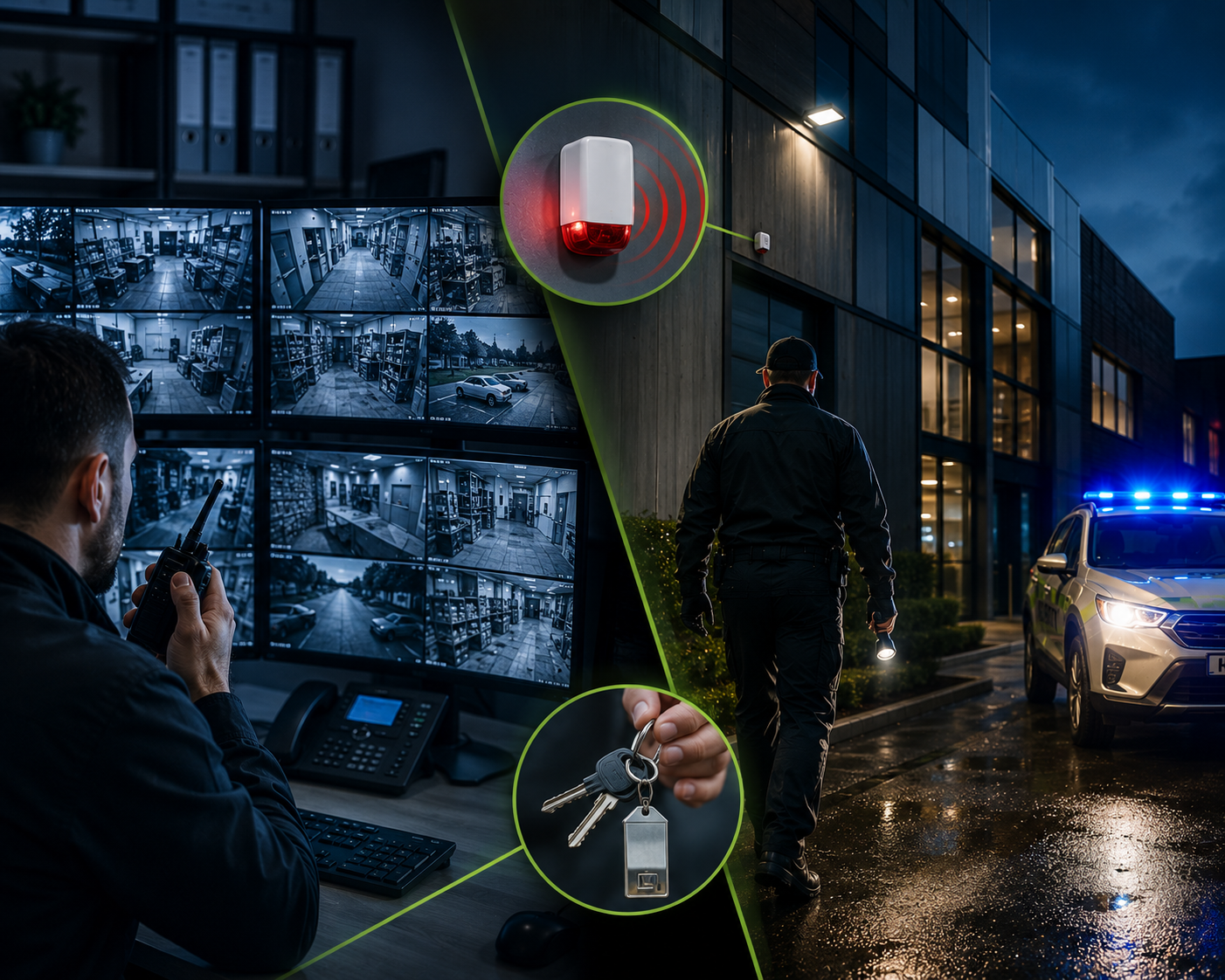
Imagine your business alarm activates at 2:17am.
Nobody is working.
The manager is at home.
The building is several miles away.
Your first question isn’t necessarily “Why did the alarm activate?”
It is:
“Who is going to the property?”
That is precisely the problem professional alarm response and keyholding services in Manchester and nationwide are designed to address.
SR Facilities Group explains that its service provides trained personnel who can respond to alarm activations, deal with potential threats and liaise with emergency services when necessary.
Why the Alarm Alone Isn’t the Whole Solution
An alarm can detect a potential problem.
It cannot physically inspect the building.
It cannot check whether a door has been forced.
It cannot determine whether an activation is genuine or false.
It cannot safely meet emergency responders at the premises.
That creates the need for a human response layer.
A professional action plan can include:
- Secure keyholding.
- Alarm activation response.
- Premises inspection.
- Emergency-service liaison.
- Incident reporting.
Manchester’s Burglary Numbers Put the Issue Into Perspective
GMP recorded 9,083 burglaries across Greater Manchester in the year to September 2025. Although that represented a 24% reduction, it still equated to thousands of reported incidents.
More recently, GMP reported that residential burglary had continued to decline, reaching around 650 incidents per month in June 2026.
The lesson for commercial premises is straightforward:
- Crime can decline.
- Risk doesn’t disappear.
- Empty premises remain vulnerable.
- Response planning still matters.
The Keyholding Element
Traditional arrangements often rely on a business owner or employee keeping the premises keys.
That can create obvious problems.
What happens if:
- They are on holiday?
- They are travelling?
- They are asleep?
- They are unwell?
- They live far from the premises?
- They don’t feel safe attending at night?
SR Facilities specifically highlights these challenges and offers professional keyholding as an alternative.
A professional keyholding arrangement means authorised personnel can respond instead.
Step 1: Alarm Activates
The first stage is notification.
- 🚨 Alarm activation occurs.
- 📞 Response procedure begins.
- 👮 Trained personnel are dispatched.
The purpose is not simply to arrive quickly, but to follow a defined procedure.
Step 2: The Site Is Assessed
The responder attends the premises and assesses the situation according to the agreed protocol.
Checks may include:
- Doors and entrances.
- Visible damage.
- Perimeter condition.
- Signs of forced entry.
- Other obvious security concerns.
The responder should not unnecessarily put themselves or others in danger.
If a genuine threat is suspected, the appropriate emergency services should be contacted.
Step 3: Emergency Services Can Be Liaised With
This is one of the practical benefits of professional keyholding.
Rather than expecting a business owner to travel to an unfamiliar situation during the night, trained personnel can manage the initial attendance and communicate with the relevant emergency services where required.
SR Facilities states that its alarm response team can liaise with emergency services when necessary.
This can reduce the pressure placed on business owners and employees.
Step 4: The Incident Is Recorded
A good security response should not simply end when the premises have been checked.
Documentation matters.
- 📝 Record what happened.
- 📷 Document relevant observations where appropriate.
- 📞 Notify the client.
- 🚨 Escalate serious concerns.
- 🔐 Help ensure the premises are left secure.
Records can help identify recurring problems and inform future security decisions.
False Alarms Are Still a Business Problem
Not every alarm activation means a burglary is taking place.
Activations can result from:
- Human error.
- Technical faults.
- Environmental factors.
- Maintenance activity.
- Unauthorised access.
That does not mean they should simply be ignored.
A consistent response procedure allows the premises to be checked and the situation properly assessed.
Why This Matters Beyond Manchester
The need for effective response isn’t unique to Manchester.
Businesses across the UK operate outside conventional working hours:
- Retail stores.
- Offices.
- Warehouses.
- Construction sites.
- Distribution centres.
- Industrial premises.
- Vacant properties.
SR Facilities Group states that it provides security solutions across the UK and operates with 24/7, 365-day availability.
Building an Effective Alarm Response Action Plan
The strongest arrangements should be established before an alarm activates.
A practical plan should define:
- Who holds the keys?
- Who receives alarm notifications?
- Where is the property?
- What are the access arrangements?
- What constitutes an escalation?
- Who should be contacted?
- What happens after an incident?
This removes uncertainty when every minute matters.
Why Keyholding and Alarm Response Are Becoming Essential
Modern business security is no longer simply about preventing someone from entering a building. It is about creating a response chain that continues after an alarm, suspicious activity report or security incident.
A well-designed arrangement provides:
- A professional response.
- Reduced responsibility for employees.
- Safer out-of-hours procedures.
- Better incident documentation.
- Greater operational reassurance.
For businesses that do not require permanent guarding, alarm response and keyholding can provide an important layer between technology and human intervention.
SR Facilities Group’s Manchester-based operation provides this service alongside manned guarding, mobile patrols and CCTV solutions, allowing businesses to build a security strategy around their actual risks rather than relying on an alarm system alone.